
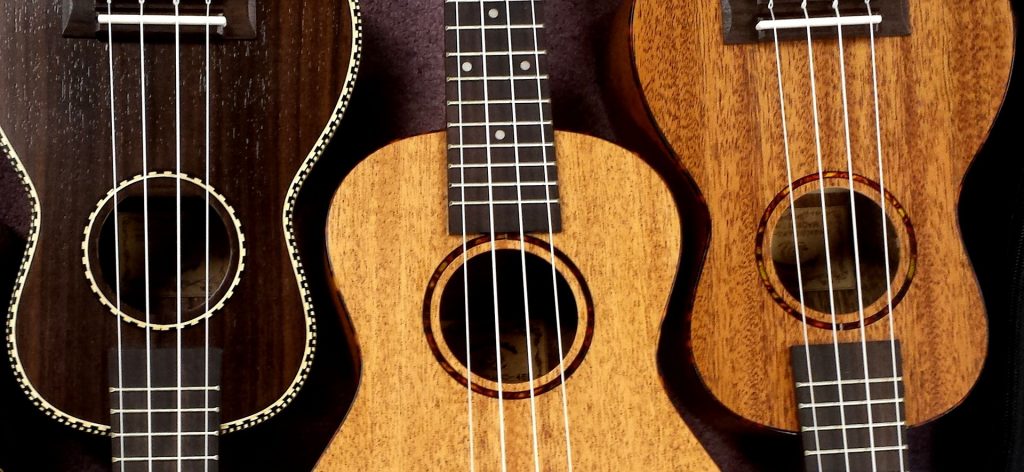
The Ukulele: History, Popularity, Learning, and Choosing the Right Style
The ukulele is one of the most recognizable small stringed instruments in the world, but its history is relatively young compared with instruments such as the guitar, violin, or piano. The modern ukulele developed in Hawaii during the late 19th century, but its roots can be traced to Portuguese immigrants who arrived in Hawaii in the 1870s. These immigrants brought small Portuguese stringed instruments, including the machete, braguinha, and rajão, which helped inspire what eventually became the Hawaiian ukulele.

It is difficult to credit one individual as the sole “inventor” of the ukulele because the instrument evolved from several Portuguese instruments.
However, three Portuguese woodworkers Manuel Nunes, José do Espírito Santo, and Augusto Dias are especially important to the development of the early Hawaiian ukulele. They were skilled craftsmen who built small four-string instruments in Hawaii. Manuel Nunes in particular is often credited with helping develop the instrument into the recognizable ukulele form.
The word ukulele is Hawaiian and is commonly translated as “jumping flea.” One popular explanation is that the name referred to the quick finger movements of a player. For those interested in selling Ukulele’s online or through any type of storefront, dropshipping is available through Wholesale Music Warehouse’s group of US dropship partners. Dealers that do not wish to stock inventory use dropshipping.
Another historical tradition connects the name with Edward William Purvis, a British army officer and musician in Hawaii who was reportedly nicknamed “ukulele.” Regardless of the exact origin, the name became permanently associated with the little four-string instrument.
The ukulele quickly became associated with Hawaiian music and culture.
Hawaiian royalty took an interest in the instrument, and King David Kalākaua was an enthusiastic supporter of Hawaiian music and arts. The ukulele became increasingly visible at Hawaiian gatherings and performances. Over time, it went from being an instrument brought by Portuguese immigrants to becoming an important symbol of Hawaiian musical identity.
One reason people love the ukulele is its friendly size. Compared with a full-size guitar, the ukulele is remarkably compact and lightweight. It can easily be carried to the beach, park, camping trip, family gathering, or vacation. A player doesn’t need a large case, amplifier, or complicated collection of accessories to get started. The simplicity and portability of the instrument are major parts of its appeal.
Another reason the ukulele is so popular is its bright, cheerful sound. The instrument has a distinctive tone that can immediately create a relaxed and upbeat atmosphere. Even simple chords can sound musical and satisfying. This makes the ukulele particularly attractive to beginners who want an instrument that can produce enjoyable music relatively quickly.
The ukulele is also popular because it can be easier on the fingers than a steel-string acoustic guitar. Traditional ukulele strings are generally made from nylon or similar materials, which are softer and have lower tension than steel guitar strings. The neck is also shorter, and the strings are closer together. Beginners can still experience some fingertip soreness while learning, but many people find the ukulele physically less demanding than a guitar.
How easy is it to learn? For most beginners, the ukulele is considered one of the more approachable stringed instruments. A new player can learn a handful of basic chords and begin strumming simple songs relatively quickly. Chords such as C, Am, F, and G7 are common beginner chords, and learning to move between several basic chord shapes can open the door to hundreds of songs.
The ukulele is similar to a guitar in several important ways. Both are fretted, plucked string instruments that use chords, scales, rhythm patterns, strumming, picking, and fingerpicking. If you already know how to play guitar, many musical concepts transfer directly to the ukulele. You already understand concepts such as chord progression, rhythm, keys, scales, and musical timing.
However, a ukulele is not simply a miniature guitar. Most standard ukuleles have four strings rather than the guitar’s six. The standard ukulele tuning is commonly G-C-E-A, while a standard guitar is tuned E-A-D-G-B-E. The ukulele’s tuning also uses a feature called reentrant tuning, where the G string is often tuned higher than the C, E, and A strings. This gives the instrument its characteristic sound.
Guitar players should also remember that the chord shapes are different. A guitar player can’t simply take every guitar chord shape and place it on a ukulele. However, many guitarists find the transition relatively easy because the underlying musical concepts are familiar. Someone who already plays guitar may quickly recognize patterns and understand how chords are constructed even though the finger positions change.
There are four primary traditional ukulele sizes: soprano, concert, tenor, and baritone. The soprano is the smallest and is often considered the classic Hawaiian ukulele size. It produces the bright, traditional ukulele sound many people immediately recognize. The concert is slightly larger, while the tenor is larger again. The baritone is the largest of the four and has a deeper, warmer sound.
The soprano ukulele is arguably the instrument most closely associated with the traditional image of the ukulele. It is compact, highly portable, and has a lively tone. It is an excellent choice for someone who wants the classic ukulele experience. However, its smaller fretboard can feel cramped for people with larger hands, so “smallest” does not necessarily mean “easiest.”
The concert ukulele is one of the most popular choices for beginners because it offers a useful compromise between compactness and playing comfort.
It has a little more room between the frets than a soprano, while retaining much of the familiar ukulele character. For someone buying their first instrument and unsure which size to select, a concert ukulele is often a very sensible starting point.
The tenor ukulele is particularly popular with more experienced players and performing musicians. Its larger body and longer scale provide additional room for the fretting hand and can produce a fuller, richer sound. Tenors are especially attractive to players who want to perform, fingerpick, or explore more advanced techniques. Many professional ukulele performers favor the tenor size.
The baritone ukulele is different from the other three sizes. It is larger and is generally tuned D-G-B-E, matching the highest four strings of a guitar. Because of this tuning, the baritone can feel particularly familiar to guitar players. Its tone is deeper and warmer than that of a soprano, concert, or tenor ukulele. It is a great option for someone who wants a ukulele-like instrument with a more guitar-oriented feel.
So which style is most commonly used? For the traditional ukulele sound, soprano, concert, and tenor instruments are the most relevant choices. The concert is particularly popular as an all-around beginner and general-purpose instrument, while tenor ukuleles are very common among serious performers. The baritone occupies a more specialized position because of its larger size, different tuning, and deeper tone.
Ukuleles also come in many different construction styles. Players can find acoustic ukuleles, electric ukuleles, acoustic-electric models, solid-wood instruments, laminate instruments, and even unusual specialty designs. Acoustic-electric models are especially useful for musicians who expect to perform onstage because they can be connected to an amplifier or sound system. Beginners, however, usually don’t need amplification and can start with a straightforward acoustic model.
The ukulele is also a wonderful gateway into other musical instruments. Someone who learns ukulele develops important skills involving rhythm, chord changes, timing, finger coordination, musical memory, and strumming. Those skills can make it easier to eventually explore guitar, bass, banjo, mandolin, or other stringed instruments. The ukulele can therefore be both a complete instrument in its own right and an excellent introduction to the world of stringed music.
Ultimately, the ukulele’s popularity comes down to simplicity, portability, affordability, and fun. It has a fascinating Hawaiian history, a distinctive sound, and a relatively gentle learning curve.
A beginner can learn several basic chords without spending months mastering complicated techniques, while an experienced musician can continue exploring fingerpicking, advanced chord voicings, music theory, soloing, and performance. For someone buying a first ukulele, a concert model is an excellent all-around choice, while a soprano is ideal for the classic compact ukulele experience and a tenor is worth considering for larger hands or more advanced playing.
